
Don’t try to climb the whole mountain on the first day. Tie your shoelaces at the trailhead, take one step, and let the habit lead you forward.
Many habits fail because we begin with too much. We decide to read for an hour, meditate for twenty minutes, or exercise for forty-five minutes every day. The plan sounds exciting at first. Then motivation drops, life gets busy, and the habit disappears.
A better approach is to make the habit so small that starting feels easy.
Use two simple ideas:
- Habit stacking: Attach the new habit to something you already do.
- The 2-minute rule: Shrink the new habit until it takes two minutes or less.
Attach the habit to something familiar
A new habit is easier to remember when it follows an old one.
You already brush your teeth, make coffee, sit at your desk, or prepare for bed. These actions happen regularly without much thought. They can become reminders for the new habit.
Use this sentence:
After I [current habit], I will [new habit].
I will…
For example:
- After I make coffee, I will write one sentence.
- After I brush my teeth, I will stretch for two minutes.
- After I sit at my desk, I will read one page.
- After I put my phone on charge, I will prepare my clothes for tomorrow.
The old habit becomes the signal. You no longer need to depend on memory or wait for motivation.
Make the first step tiny
Now shrink the new habit.
If you want to read more, start with one page.
If you want to exercise, start with one push-up.
If you want to write, start with one sentence.
If you want to meditate, sit quietly for two minutes.
This may seem too small to matter. That is exactly why it works. The brain often resists the beginning of a task more than the task itself. A large habit feels like a serious commitment. A two-minute habit feels safe.
The first goal is not to finish a full workout or write a complete chapter. The first goal is to teach your brain:
This is what I do after this familiar action.
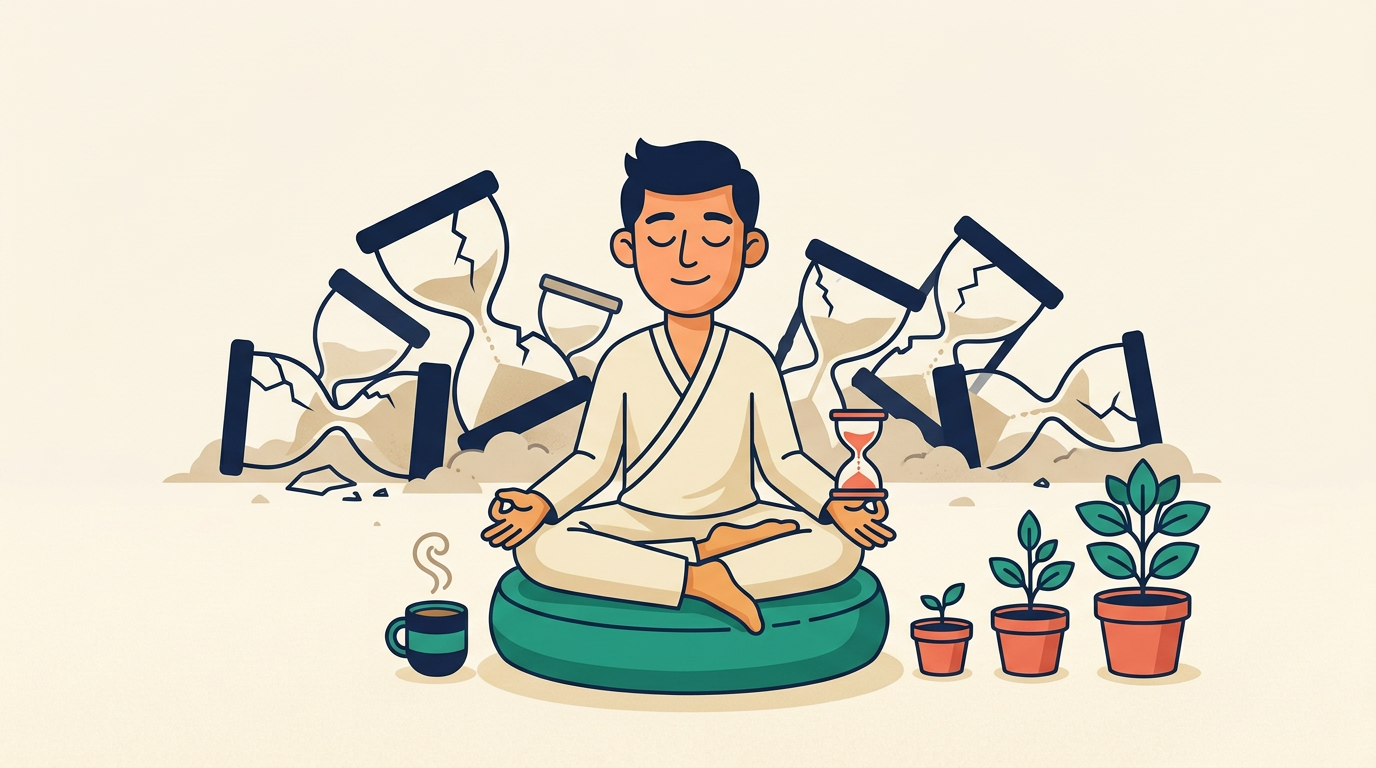
The man who could not meditate
A man wanted to meditate for twenty minutes every morning. He had tried six times and quit every time.
Then he changed the plan:
After I pour my morning coffee, I will sit on my cushion for two minutes.
Two minutes felt almost too easy. He could not find a good reason to avoid it.
By the third week, sitting down had become automatic. Some days he stayed for ten minutes without forcing himself. By the third month, he was meditating for about fifteen minutes most days.
He did not build the habit by forcing himself to meditate for twenty minutes. He built it by sitting down for two minutes.
The earlier plans were too large for the person he was at that time. The smaller plan gave him a starting point he could actually repeat.
Why small habits work
BJ Fogg’s behavior model says that three things usually need to meet for a behavior to happen:
- Motivation: You want to do it.
- Ability: You are able to do it easily.
- Prompt: Something reminds you to begin.
Habit stacking provides the prompt. The 2-minute rule makes the habit easy. This means motivation becomes less important.
That matters because motivation changes every day. Some mornings you feel ready. Other mornings you are tired, busy, or worried. A habit that requires strong motivation will often disappear on those days.
A small habit has a better chance of surviving real life.
The two-minute habit is the foundation
Do not treat the small version as a weak replacement for the real habit. It is the beginning of the real habit.
One page of reading may lead to ten pages. One push-up may lead to a full workout. One sentence may lead to a page. Two minutes of meditation may become fifteen.
Sometimes you will continue. Sometimes you will stop after two minutes. Both are useful because you kept the promise and repeated the pattern.
A person who reads one page every day is building the identity of a reader. Someone who plans to read for an hour but never opens the book is still waiting for the habit to begin.
Make starting easier
Look for anything that creates friction before the habit starts.
- Keep the book on your pillow.
- Leave your exercise clothes beside the bed.
- Place your journal next to your coffee cup.
- Keep your meditation cushion where you can see it.
- Open the writing document before you go to sleep.
- Remove the app or snack that pulls you away from the habit.
Your goal is to make the first step easier than the excuse.
If you have to search for your shoes, clear your desk, find your notebook, and decide what to do, you have already created several chances to quit. Prepare the path in advance. Thoda sa intizam at night can make the morning much easier.
Give it time
A new habit does not become automatic in a few days. Research by Phillippa Lally found that habit formation took an average of about 66 days, although the time was different for each person.
The important part was repeating the behavior in the same situation. The exact length of the behavior mattered less than returning to the same cue again and again.
That is why consistency matters more than intensity at the beginning.
Try this:
- Choose one habit you have failed to build.
- Find something you already do every day.
- Write the sentence: “After ___, I will ___.”
- Make the new action take two minutes or less.
- Repeat it for fourteen days without making it bigger.
- Scale it only after the small version feels natural.
Do not make the habit harder just because you had one good day. Let your brain learn the pattern first. Then grow it slowly.
Real change often begins with an action so small that nobody else notices. But you notice. Each repetition gives you a little more yaqeen that this is simply what you do now.
You don’t rise to the level of your ambitions. You sink to the level of your smallest reliable action.
- Habit StackingS.J. Scott / James Clear
- The 2-Minute RuleJames Clear
- Fogg Behavior Model (B=MAP)BJ Fogg
- Habit Formation CurvePhillippa Lally
- Cue–Behavior AutomaticityVerplanken



Comments (0)
Leave a Reply
No comments yet. Be the first to share your thoughts!