
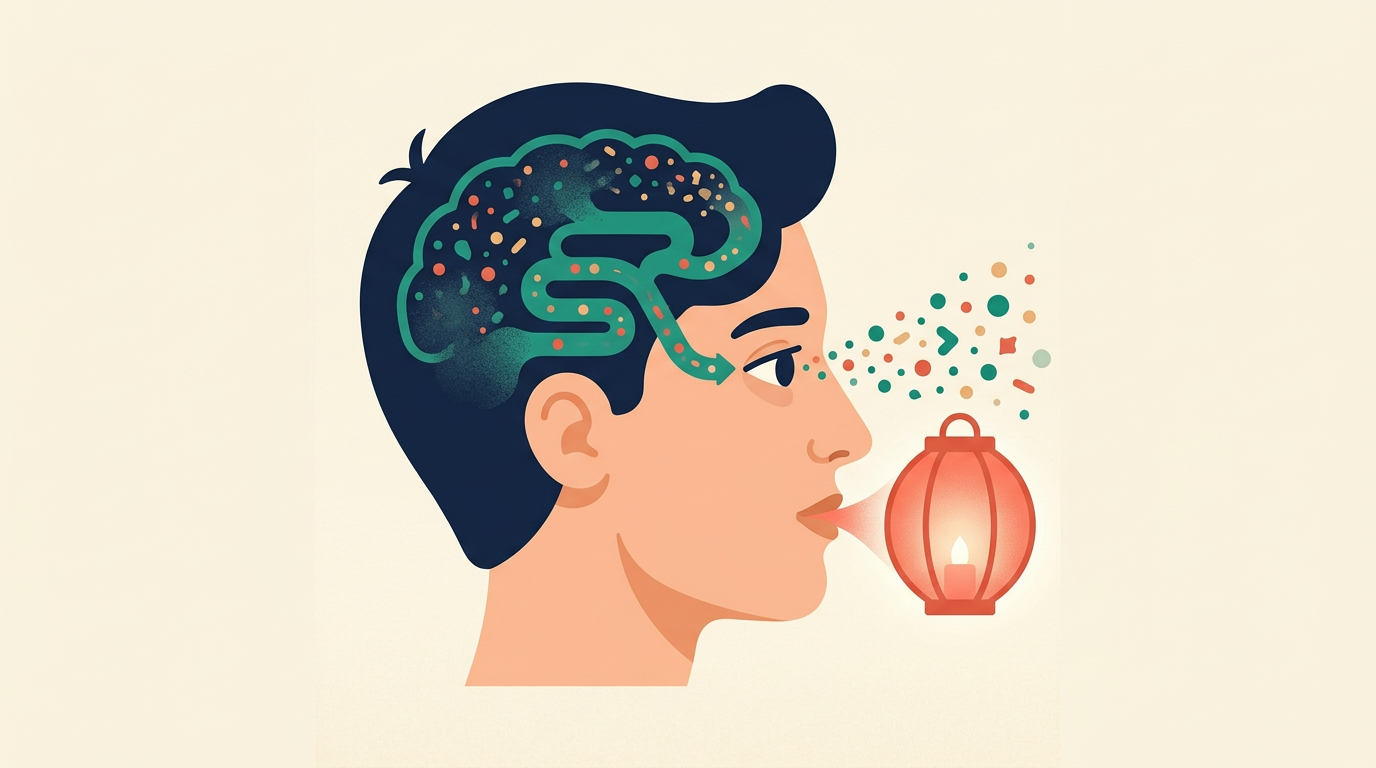
If you can’t explain something simply, you may not understand it yet. You may only recognize the words because you have seen them before.

This is why rereading a chapter can feel so productive. The pages look familiar, the sentences seem clear, and you leave with the feeling that you know the material.
Then someone asks you to explain it without the book, and your mind goes blank.
Real learning appears when you can bring the idea back from memory and explain it in your own words.
Why rereading can fool you
When you read the same page several times, your brain becomes familiar with its shape and wording. That familiarity feels like knowledge.
But recognizing information is easier than producing it.
You may think:
“I understand this. It looks familiar.”
Then the exam, meeting, or real-life problem asks you to use the idea without showing you the answer. That is when the difference becomes clear.
Rereading helps you recognize the material. Active recall helps you retrieve it.
The medical student who changed her method
A medical student reads a chapter about the heart three times. She highlights important lines and feels prepared.
During the exam, she struggles with questions that ask her to apply the information. She remembers the page, but she cannot explain the process clearly.
Another student reads the chapter once, closes the book, and writes out the cardiac cycle as if explaining it to a high-school student.

She gets stuck at the AV node. Instead of starting the whole chapter again, she looks up only that section. Then she closes the book and explains the cycle again.
After two more attempts, she can describe the full process without notes.
She spent less time reading, but she learned more. The first student mistook familiarity for understanding. The second student used difficulty as a way to find the gaps.
The Feynman Technique
The Feynman Technique is a simple way to test whether you understand an idea.
1. Choose one topic
Do not start with an entire subject. Pick one clear idea.
Examples:
- How the heart pumps blood.
- Why interest rates affect prices.
- How photosynthesis works.
- Why people procrastinate.
- What caused a historical event.
2. Explain it in simple language
Pretend you are explaining it to a curious 12-year-old.

Use short sentences. Avoid technical words unless you explain them. Imagine the other person is intelligent but has never studied the topic.
Write or speak the explanation from memory.
3. Notice where you get stuck
Pay attention to the moments when you:
- Stop and search for words.
- Use a difficult term instead of explaining the idea.
- Skip a step.
- Say “it just happens.”
- Feel tempted to open the book.
These moments show you where your understanding is weak.
Every piece of jargon you use to hide confusion is a sign that you may need to look more closely.
4. Review only the gap
Open your notes and study the part that caused trouble. Do not reread everything from the beginning.
Then close the book and explain that section again.
Repeat until the explanation becomes clear and natural.
Add active recall
Active recall means trying to bring information back without looking at it.
You can use it in many ways:
- Close the book and write everything you remember.
- Answer questions before checking the answers.
- Explain a topic out loud.
- Use flashcards.
- Draw a process from memory.
- Ask yourself what, why, how, and when.
It may feel harder than rereading. That is expected.

In a well-known study by Henry Roediger and Jeffrey Karpicke, students who practiced remembering information performed much better on later tests than students who spent the same amount of time rereading. Interestingly, the students who recalled the material often felt less confident at first.
That feeling can be misleading. Easy study can feel good while creating weak memory. A little struggle can show that your brain is building a stronger path.
Use spaced recall
Do not recall the information only once and assume it is safe.
Bring it back at increasing gaps:
- A few minutes after studying.
- The next day.
- Three days later.
- One week later.
- Two weeks later.
Each time you remember the idea just before it fades, you strengthen the memory.
You do not need to study for hours each time. A few minutes of honest recall can be more useful than another full rereading session.
A simple study session
Try this method during your next learning session:
- Study one small topic for 20 to 30 minutes.
- Close the book or notes.
- Write an explanation in simple language.
- Circle every place where you get stuck.
- Check only those parts.
- Explain the topic again without looking.
- Test yourself tomorrow.
You can use a blank page with four headings:
If you cannot answer one of these, you have found the part that needs more attention.
Do not wait to feel ready
Many learners keep rereading because active recall feels uncomfortable. They think they should study more before testing themselves.
That delays the most useful part.
Start recalling early, even when your memory feels incomplete. You are not taking the test to prove that you already know everything. You are using the test to find what needs work.
Your first explanation may be messy. That is fine. Correct it, try again, and let the gaps guide your study.
Aap ko shuru mein yaqeen kam mehsoos ho sakta hai, but that is not proof that the method is failing. It may be proof that you are finally testing real understanding instead of recognition.
The next time you study, do not ask only, “How many times did I read this?”
Ask:
Can I close the book and explain it clearly?
That question will show you what you truly know.

Understanding is not what enters your eyes. It is what survives the journey back out through your mouth.
- The Testing EffectRoediger & Karpicke
- The Generation EffectSlamecka & Graf
- The Forgetting CurveHermann Ebbinghaus
- The Feynman TechniqueRichard Feynman
- Desirable DifficultiesRobert Bjork

Comments (0)
Leave a Reply
No comments yet. Be the first to share your thoughts!