
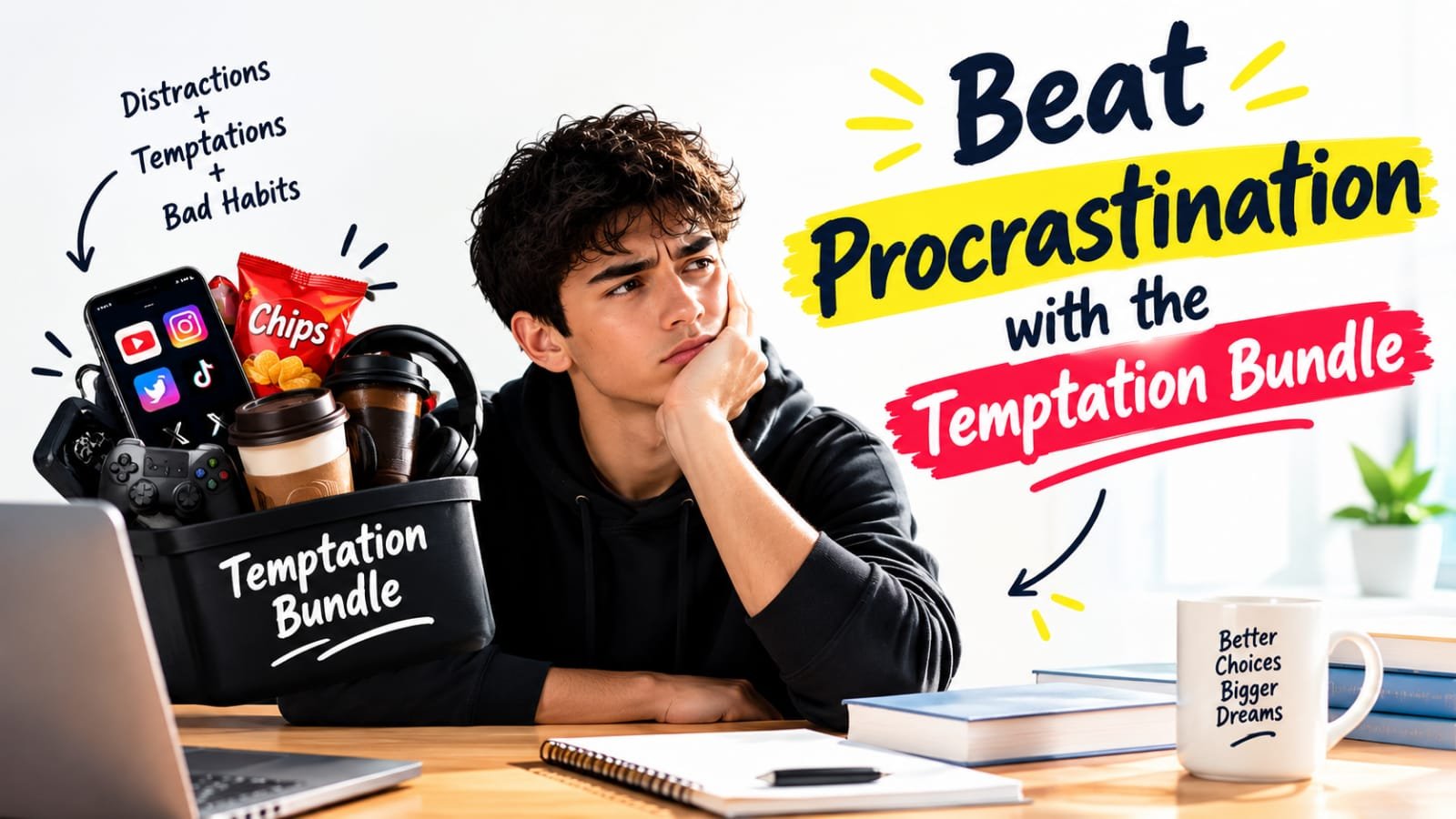
You may not lack discipline. You may simply need a system that connects something you should do with something you already want to do.

This is called temptation bundling.
You pair an unpleasant task with an enjoyable activity. The task gives you access to the reward, and the reward gives you a reason to begin.
For example:
- Listen to your favorite podcast only while cleaning.
- Watch your favorite show only while folding laundry.
- Drink your special coffee only while writing.
- Listen to a favorite playlist only while exercising.
The task stays the same. The reason for starting changes.
Why procrastination feels so reasonable
Procrastination is often blamed on laziness. But your brain is usually making a short-term calculation.
It sees:
- The effort you must make right now.
- The reward you may receive later.
The effort feels real and immediate. The reward feels far away. So the brain chooses the easier option, even when you know the important task will help you in the long run.
This is called present bias. Your brain gives extra importance to what feels good now and less importance to what may help you later.
That is why checking your phone can feel easier than starting a report. The phone offers an immediate reward. The report may not reward you until tomorrow, next week, or much later.

Temptation bundling brings part of the reward into the present.
The graduate student and the podcast
A graduate student kept avoiding the data-entry work for her thesis. The task was boring, and she often spent Sunday afternoons finding other things to do.
She loved a true-crime podcast, but only listened during her short daily commute. She changed the rule:
I can listen to this podcast only while doing thesis data entry.
The first Sunday, she worked for four hours. A task that had taken her three weeks was nearly finished in one afternoon.

She had not suddenly become more disciplined. The work had not become more interesting. She had simply connected the boring task to something she already wanted.
The reward used to come before or after the work. Now it came during the work, so beginning no longer felt like such a heavy cost.
The science behind the method
Researcher Katherine Milkman tested this idea with gym members. Some people were allowed to listen to tempting audiobooks only while exercising.
Those people went to the gym about 51 percent more often than the comparison group.

The audiobook gave them an immediate reason to exercise. They no longer had to depend completely on a future reward, such as better health or a changed body.
This idea also connects to a simple behavior rule called the Premack principle:
A behavior you naturally want to do can encourage a behavior you usually avoid.
In everyday language, it means you can use a favorite activity as the reward for completing a less enjoyable one.
The reward must be exclusive
This is the most important part.
The enjoyable activity must be available only while you are doing the task you want to build.
If you listen to your favorite podcast while sitting on the sofa, you can get the reward without doing the work. Your brain has no reason to connect the two activities.

So make a clear rule:
- Podcasts are for cleaning time only.
- The favorite show is for folding laundry only.
- The special coffee is for writing time only.
- The playlist is for running time only.
The reward should be tempting enough to make the task feel worthwhile. If you can easily live without it, the bundle will not be strong enough.
How to create your own bundle
1. List what you enjoy
Write down three things you want to do but usually limit.
Examples:
- Podcasts.
- Audiobooks.
- Favorite shows.
- Specialty coffee.
- Social media.
- Video games.
- A favorite snack.
- Music or playlists.
Choose something you genuinely look forward to.
2. List what you avoid
Now write down three tasks you should do more often.
Examples:
- Cleaning.
- Exercise.
- Writing.
- Studying.
- Meal preparation.
- Filing paperwork.
- Answering important emails.
3. Match one from each list
Look for a pairing that makes sense.
- Podcast plus washing dishes.
- Show plus folding clothes.
- Coffee plus writing.
- Audiobook plus walking.
- Favorite playlist plus exercise.
The task should be possible while you enjoy the reward. You cannot watch a show while driving or listen to a podcast during a meeting that requires deep focus.
4. Set the rule for two weeks
Use the reward only during the task for fourteen days.
There may be a little resistance at first. Your brain is learning a new connection. Stay consistent long enough for the pairing to feel familiar.
If the task still feels too large, make it smaller. Clean for ten minutes. Write one paragraph. Walk for five minutes. The goal is to begin regularly, not to create an impressive plan you cannot keep.
A few rules that make it work
- Choose a real reward. Pick something you already want, not something you think you should enjoy.
- Keep the rule clear. “I can listen to this podcast only while walking” is stronger than “I will try to walk more.”
- Protect the connection. Do not use the reward when you skip the task.
- Start small. Make the first version easy enough to repeat.
- Review after two weeks. Keep the bundle if it helps. Change it if the reward is too weak or the task is still too difficult.
The aim is to make starting feel less like a fight. Thoda sa clever setup can save you from needing a fresh supply of willpower every day.
Your next step
Take a sheet of paper and make two columns.
Things I want to do
Things I keep avoiding
Choose one pair. Then write the rule:
I can enjoy __________ only while I am doing __________.
Follow that rule for two weeks. Do not give yourself the reward first and hope the work follows. Let the enjoyable activity pull you toward the task.
Over time, the task may still be boring. That is fine. You do not need to love every part of your life. You need a system that helps you begin.

Discipline is what people call a system they can’t see. Build the system and let them call you disciplined.
- Temptation BundlingKatherine Milkman
- Premack PrincipleDavid Premack
- Present BiasO’Donoghue & Rabin
- The Procrastination EquationPiers Steel
Comments (0)
Leave a Reply
No comments yet. Be the first to share your thoughts!